Posts

Sharp-shinned Hawk

Image
I had just finished watching  Into the Okavango  when it happened. My mind was filled with hippos, elephants, red ball suns and paddling when out of the corner of my eye I saw two birds fly towards the dining room glass door. One I thought might be Eurasian Collared Dove as it was big and light under the wing. The other bird was dark. Oh no, I thought. The thunk was barely audible. I hopped up, hoping that if a bird were injured it would be the Collared Dove. There was a bird injured. It wasn't the Collared Dove. In fact there was no Collared Dove on the scene. The bird I thought was a dove was actually a juvenile Sharp-shinned Hawk and it had firmly pinned a Starling to our snowy deck. The Starling was in rough shape but was trying to fight back, pecking at the hawk every time the hawk lowered its head to bite. I did the only thing that there was to be done. I ran and got my camera. I knew that getting a good picture would be a challenge. As mentioned previously, ...

Red bellied woodpecker.

Image
The weather has been wintry of late. Not surprising since this is February and of course winter. But temps have been well below normal and it's been gray. Truthfully, getting out has been a challenge. I do find that having been to the Arctic makes the cold more bearable. I turn my face north and think about polar bears and whales and Arctic fox. That and good snow pants and thick socks (I had a non-freezing cold injury on my feet when I was a teen so in my middle age I find I have to be extra careful about these things) help get me through. I also enjoy my little forays when I can. I did go to the Farm Island bird feeder recently where I finally got a photo of the red bellied woodpecker. It's belly isn't brilliantly red, at least this female's belly in February isn't. If you zoom into the photo where she's facing the camera you will see the faintest blush of orangey red on her breast, a paler version of the color around her beak. I feel particularly...

Badlands

Image
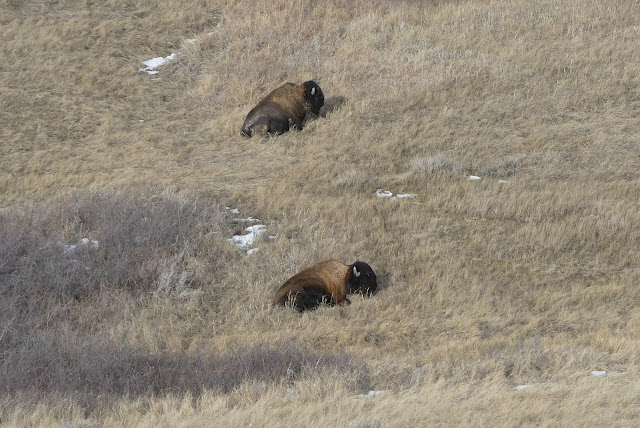
Mild weather, needing erosion pictures for a class I'm teaching, and Polar Vortex induced cabin fever sent me to the Badlands yesterday. That and a vague worry about the how the park, particularly the bison, fared during the shutdown. To set your mind at ease, the park looked in fine condition. The campground was not vandalized in anyway that I could see. The bison, the few that I saw, looked good. Plump. Relaxed. Lounging in the sun on a warm winter day. I had hoped to get a lot of close ups of the bison as this was my first spin in the park with my new camera but other than this pair basking in the sun by the side of the road the bison were all far afield, visible only as tiny bison dots through my binoculars. Perhaps a super high end digital single lens reflex camera, the kind with a two foot lens, might have gotten a good picture but I was pretty sure this was beyond what my little camera could handle. No matter. There were plenty of things to photograph. Like...

Jolly Good Fellow

Image
That is me, the woman on the left in a blue shirt. I am a 2019 National Geographic Education Fellow. This blog really isn't about my work with National Geographic but when you put yourself out there as an explorer even of the every day variety and you end up working with National Geographic some explanation is in order. My work with National Geographic is to build out their citizen science resources for teachers.  Being a citizen scientist myself I think this is important, essential work to getting to a Planet in Balance. I won't be going any place exotic like the Okavango (unless National Geographic thinks they need an education fellow to go to help with... I don't know what I could help with but I'm game to go). My fellowship work may or may not show up in this blog and if it does it may be direct i.e. talking about it specifically or indirect talking about an experience because of that work. This blog will still be about my observations and the work ...

Old Blogs Never Die

Image
If it's on the internet, it lives forever. I had half forgotten about an online nature journal I kept about four years ago which was something of a precursor to this one. I eventually replaced it with iNaturalist, never to return to that work. I won't reactivate it but I do think it belongs as part of the archive for this blog. This is one of my favorite photos from that blog taken with an old phone. This was taken on the causeway from Pierre to La Framboise Island.

Bird Land

Image
I am enjoying my new camera. I am practicing the same skills I was when I last posted which means there are features on my camera I still don't know how to use. No matter. For the moment I am enjoying learning how to take pictures of birds at the feeder maintained at a nearby state park by volunteers from the Audubon Society. When I am ready to learn more about the camera, I will move on. Today is National Bird Day so I will share a few bird photos. I find taking halfway decent photos of birds unexpectedly gratifying, especially when I share them on iNaturalist. The photos I'm sharing below aren't my best photos but the ones that I am learning from. What I've learned so far: I've learned that snow is hard to get the right light. The birds in the photos I took on a snowy day come out a little dark. See the American tree sparrow photo one below. I've learned that autofocus may or may not always pick the right thing to focus on. I've had more than one p...

Early morning eagles.

Image
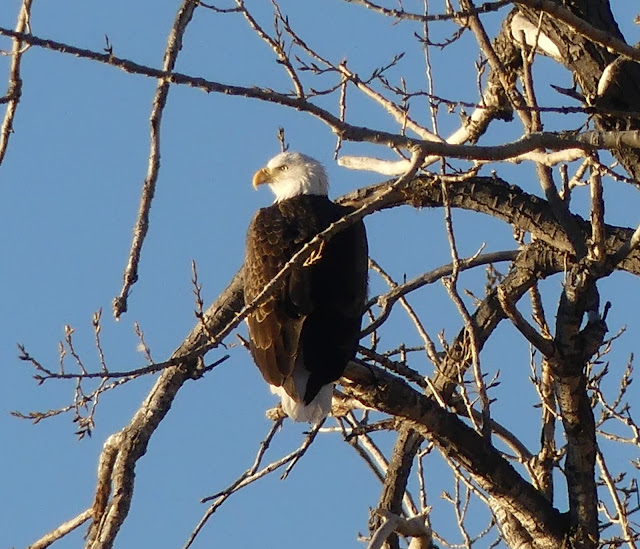
I am learning that one of the things you do as a photographer is chase the light, particularly the golden hours around sunrise and sunset. I know a man who specializes in photographing sunrises. He regularly gets up at or before 4 am to check the weather, make coffee and decide if it's worth a drive to the spots that he knows will yield stunning sunrise photos . I am not there yet, particularly with that getting up before 4 am business. However, I did find myself getting up and out before 7:30 am on a Sunday morning to take pictures of eagles. I feel that this is sort of the same thing. Finding eagles is easy around here as eagles overwinter by the Oahe Dam about six miles out of town, attracted by the open water and cottonwood trees. Eagles are large, photogenic birds that unlike their smaller cousins don't flit. Generally if you are quiet and still they will be as well until something calls them to take flight. In populated areas they move if there is too much human...